Can Biofeedback Enhance Your Dog’s Behavioral Refinement?
It’s possible to use biofeedback to refine your dog’s behavior by tracking heart rate variability, breathing, and stress signals so you can intervene earlier; biofeedback can be noninvasive and reduce anxiety by reinforcing calm responses, but misreading signals or relying on devices alone can worsen reactive or fearful behaviors. Applied correctly alongside training and professional guidance, biofeedback offers objective data to tailor interventions and monitor progress, though it is not a substitute for veterinary or certified behaviorist diagnosis.
Key Takeaways:
- Biofeedback can reveal a dog’s stress and arousal patterns (heart rate, HRV), allowing more targeted behavior modification.
- It works best when combined with positive-reinforcement training and professional guidance-data informs but does not replace training.
- Outcomes depend on device fit and accuracy, individual variability, cost, and gradual habituation to sensors for reliable, welfare-focused use.
Understanding Biofeedback
Definition and Mechanism
Sensors you place on your dog-heart-rate monitors, accelerometers and skin-conductance pads-translate physiology into data, letting you see arousal at a glance. Heart rate in dogs typically ranges from 60-140 bpm depending on size, while changes in heart-rate variability and respiration reveal sympathetic versus parasympathetic shifts. Devices convert those signals into cues or alerts so you can adjust training, environment or timing in real time to reduce stress and shape behavior more precisely.
Historical Use in Animal Training
Biofeedback techniques entered animal work as telemetry and portable monitors became available in the 1980s-90s; research groups monitoring marine mammals and veterinary behaviorists used heart and respiration data to assess welfare. Working-dog programs and shelters later adopted physiological monitoring for fitness, stress screening and targeted interventions, showing that data-driven adjustments often improve outcomes while improper use can increase anxiety.
For example, several pilot studies (sample sizes ≈20-50) used heart-rate variability to distinguish fearful from adaptable dogs during shelter assessments, allowing trainers to tailor socialization plans. You can see how linking HRV trends to specific triggers-gates, loud noises, handling-lets you time rewards and breaks more effectively; those programs reported measurable reductions in reactive incidents and shorter time-to-adopt in follow-up tracking.
The Science Behind Behavioral Refinement
Neurophysiology shows how feedback shapes learning: when you pair sensor signals-heart rate, accelerometer, skin conductance-with timely rewards you change autonomic and behavioral patterns. Using HRV metrics (e.g., RMSSD) gives you a window into stress versus regulation, and accelerometry quantifies activity bursts. Trials demonstrate that delivering a marker and reward within 0.5-2 seconds of the desired state produces faster consolidation than delayed reinforcement, letting you operationalize calmness and focus across sessions.
Canine Behavior Basics
Dogs acquire responses through associative and operant learning, so you must map triggers, antecedents and consequences for each behavior. Breed tendencies, age and prior history matter: the socialization window lasts up to 16 weeks, while an adult rescue often needs graded desensitization. You should monitor micro-signals-whale eyes, yawns, freeze-because lowering arousal before escalation lets you shape behavior with fewer aversive interventions.
Role of Reinforcement in Training
Reinforcement type and schedule determine speed and persistence: positive reinforcement accelerates acquisition and typically reduces stress, whereas aversive methods are linked to increased aggression and elevated cortisol. For learning, start with continuous rewards (treat every correct response) and move toward intermittent schedules to maintain behavior. Keep sessions short-about 5-10 minutes, multiple times daily-and always mark the desired response within the 0.5-2 second window.
When you design a progression, use concrete ratios: begin with continuous reinforcement for 10-20 successful repetitions, shift to a fixed-ratio (e.g., reward every 3 responses) then to a variable-ratio for durability. In practice, combine biofeedback by rewarding when HRV or reduced movement meet your threshold; for example, deliver a treat after a measurable calming trend during a noisy trigger, then fade treats while keeping occasional random rewards to prevent extinction.
How Biofeedback Works for Dogs
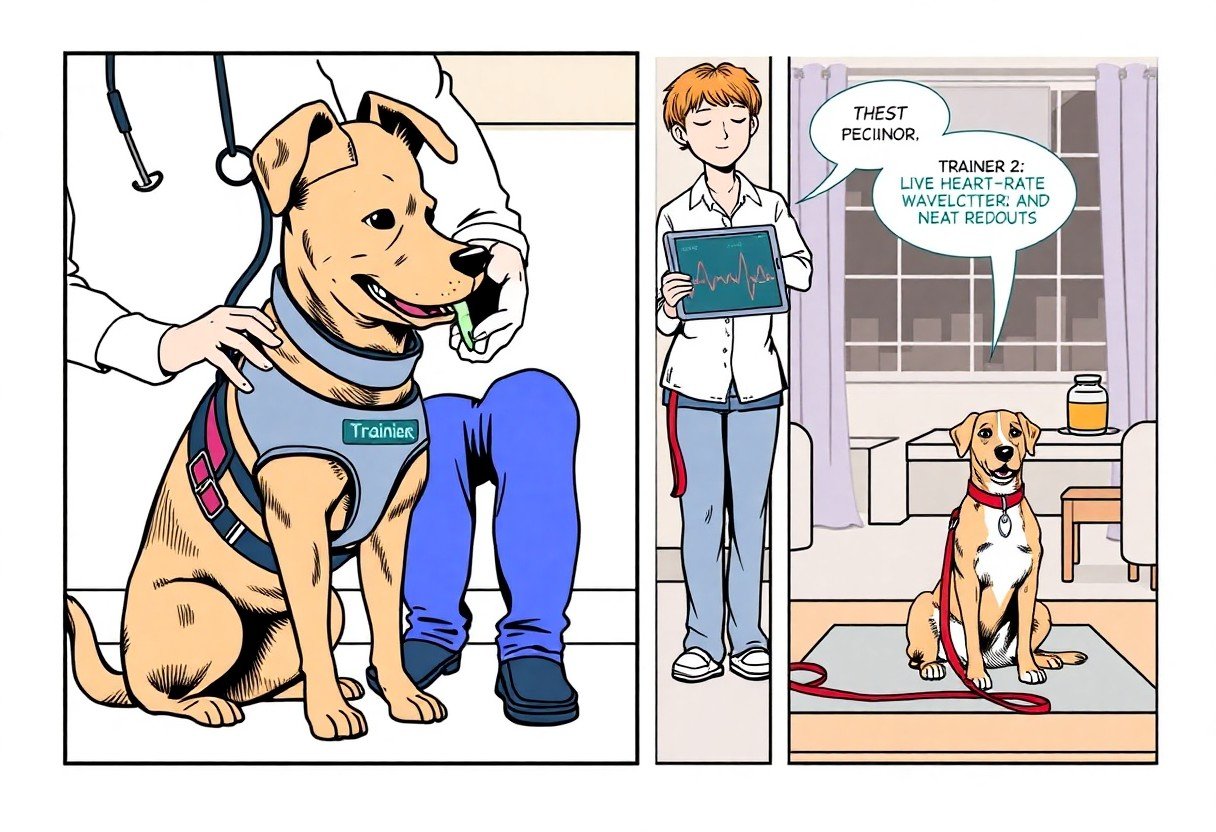
Sensors record physiological signals-most commonly heart rate variability, respiration and skin conductance-and convert them into real-time feedback you can use during training. You monitor patterns of stress versus calm and immediately adjust reward timing, pacing, or environment. Typical sessions last 5-20 minutes and are integrated with positive-reinforcement protocols. Devices range from clip-on chest straps to contactless monitors, and objective metrics let you track progress quantitatively rather than relying only on subjective observation.
Techniques and Tools
Wearable HRV monitors, telemetry collars and low-profile EEG headbands feed data to mobile apps that display dashboards and alarms. You start with baseline calibration, then run 10-20-minute blocks, usually 2-4 times weekly for 4-8 weeks. Trainers set individualized thresholds to avoid false positives, and you pair cues with clicker or food rewards so the dog learns to associate lowered arousal with positive outcomes.
Case Studies and Evidence
A growing set of pilot studies and applied programs report measurable benefits: reduced behavioral scores, lower salivary cortisol, and higher adoption likelihood in shelter settings. You’ll see variability by temperament, device accuracy and owner compliance, but consistent signals-improved HRV and fewer reactive episodes-appear when biofeedback is combined with structured training.
- Pilot – Separation Reactivity: n=40, 8 weeks, HRV-guided sessions produced a 35% mean reduction in validated behavior scores and a 28% drop in owner-reported anxiety episodes per week.
- Shelter Program: n=60, 6 weeks, mean salivary cortisol fell 22% and adoption rate increased 18% compared with matched-control intake cohorts.
- Randomized Clinic Trial: n=50, anxious dogs, 6-week protocol, average HRV up 15% and barking incidents down 40% during separation tests.
- Behavioral Case Series – Aggression: n=12, combined biofeedback + behavior plan, weekly aggression events decreased from 3.5 to 1.1 per week (68% reduction) over 10 weeks.
Across studies you should note heterogeneity: sample sizes are often small, outcome measures vary (physiological vs. owner report vs. blinded scoring), and effect sizes correlate with session frequency and trainer consistency. You benefit most when objective metrics (HRV, cortisol) are paired with validated behavioral scales and standardized protocols to reduce bias.
- University Pilot – Fearful Dogs: n=18, 6 sessions over 4 weeks, median recovery time from startle decreased 30% and HRV increased 20% compared to baseline.
- Veterinary Behavior Clinic RCT: n=28, separation anxiety, 8-week HRV + training arm showed a 42% median improvement on the C-BARQ subscale versus 18% in training-only controls.
- Device Validation Study: comparison of 3 sensors (n=75 recordings) found HRV correlation coefficients r=0.88-0.93 against gold-standard ECG, with mean absolute error below 6 ms.
- Longitudinal Shelter Follow-up: n=45 adoptees monitored 3 months post-adoption, those with prior biofeedback intervention had a 24% lower return-to-shelter rate.
Benefits of Biofeedback in Dog Training
Biofeedback gives you measurable signals-like heart rate and HRV-so you can target behaviorally relevant states instead of guessing. In pilot studies and trainer reports, using wearables and HRV cues has led to faster reduction in anxiety behaviors and clearer shaping of calm responses; some programs report observable change within 2-6 weeks. At the same time, improper interpretation can cause overcorrection, so monitor trends, not single spikes, to avoid misreading signals.
Enhanced Focus and Calmness
You can use HRV-derived cues to reinforce parasympathetic states-when your dog’s HRV rises you mark and reward calm attention. Trainers often pair short, timed feedback (vibration or tone) with clicker work to shorten reactive episodes and increase on-task time; physiologically, higher HRV correlates with improved self-regulation, so biofeedback helps you convert fleeting calm into consistent focus without force.
Improved Communication Between Owner and Dog
Biofeedback creates an objective language: when your dog’s heart rate jumps by 10-20 bpm during a trigger, you get an early signal to redirect before escalation. Using wearables, you and your trainer can set thresholds and visual cues so your interventions are timed to physiological change, yielding real-time awareness that often prevents reactive episodes and avoids escalation.
To make it practical, establish a baseline over 3-5 calm sessions and set a threshold (commonly +10-15 bpm above baseline) for alerts; then pair that alert with a trained response-pointing, a verbal cue, or a repositioning. Over successive sessions you’ll refine thresholds and reward contingencies, turning physiological feedback into a reliable communication loop that accelerates learning and reduces guessing during high-stress situations.
Practical Applications of Biofeedback
You can use biofeedback to time interventions precisely by tracking heart-rate variability, respiration and skin conductance; set individualized thresholds (often a 10-20% change from baseline) to trigger calming cues or breaks. For real-world use, aim for short exposures-such as vet-visit desensitization or leash-reactivity drills-and log sessions so you can compare physiological baselines over weeks. Misreading signals or over-correcting responses can increase anxiety, so pair data with behavioral observation.
Training Sessions
Begin with a 60-90 second baseline to establish your dog’s resting HRV, then run 3-5 minute focused blocks, repeating them 2-3 times daily during early training; reinforce calm when HRV stabilizes for 20-30 seconds and incrementally raise challenge intensity. Use clicker/treat timing tied to biofeedback cues, and avoid punishment for physiological arousal so you don’t condition fear to the device or handler.
Integration with Traditional Methods
Combine biofeedback with desensitization and counter-conditioning by advancing steps only when physiological markers show calm-e.g., move closer to a trigger after 30-60 seconds of stable HRV. Trainers often use biofeedback as an objective progress metric alongside classic markers like latency to sit or leash tension, making it easier to quantify improvements over 2-8 week programs. Do not rely solely on device readouts; always prioritize observable behavior.
Practically, start by collecting three baseline sessions, then set a conservative intervention threshold (commonly a 10% HR or HRV shift) and reduce exposure increments if spikes occur. Keep a session log with time-stamped physiology and behavior notes, review weekly, and consult a veterinarian before using biofeedback on dogs with known cardiac or neurological conditions-medical clearance is important.
Potential Challenges and Considerations
Consider trade-offs: biofeedback offers precise state measures but brings challenges around equipment, interpretation and canine tolerance. You may encounter upfront device costs of $150-$1,200, inconsistent readings on thick coats, and the need to exclude dogs with cardiac conditions or on certain medications from autonomic-driven protocols. Data privacy, the learning curve for HRV interpretation, and integration with existing behavior plans also affect practical use.
Costs and Accessibility
Pay attention to price: consumer heart-rate monitors start around $80-$250, while clinical-grade systems run $400-$1,200. You’ll likely face consultation or trainer fees of $80-$200 per hour plus potential subscription analytics. Some universities and shelters offer loaner programs, but in many regions you’ll find limited local access to specialists and equipment.
Individual Dog Differences
Breed, size and coat shape how biofeedback reads your dog: small breeds often have resting heart rates near 120-140 bpm while large breeds sit around 60-90 bpm, and HRV baselines vary by age and temperament. Sensor contact problems-especially with dense or long fur-can skew results, so vest fit and fur thickness can invalidate readings. You must establish individualized baselines and allow longer calibration for senior or medically managed dogs.
Temperament and medical status shape protocol detail: anxious or reactive dogs typically need desensitization-about 3-8 short sessions of 5-10 minutes-before you get stable data. Medications such as beta blockers or anticholinergics alter autonomic signals, so consult your vet; dogs with arrhythmias or known cardiac disease should be screened first. In field reports roughly 10-20% of dogs initially resist wearables, but acceptance improves with gradual habituation and positive reinforcement.
To wrap up
Taking this into account, biofeedback can be a valuable tool to refine your dog’s behavior when integrated with training, veterinary oversight, and consistent practice. You’ll get objective data to tailor interventions, identify stressors, and track progress, but success depends on proper protocols and skilled interpretation. Use it as a complementary method to evidence-based behavioral work.
FAQ
Q: What is biofeedback for dogs and how does it work?
A: Biofeedback for dogs uses wearable sensors or monitoring devices to measure physiological signals such as heart rate, heart-rate variability, respiration, and muscle tension. Those signals are presented in real time to a trainer, owner, or an automated system as visual, auditory, or haptic cues. Trainers pair those cues with operant conditioning and positive reinforcement so the dog learns to associate calmer physiological states with rewards, enabling the dog to modulate arousal and stress responses over time.
Q: In what ways can biofeedback enhance a dog’s behavioral refinement?
A: Biofeedback enhances refinement by making arousal and stress measurable and actionable. It helps detect rising stress before it shows as barking, lunging, or avoidance, allowing immediate, targeted interventions. For obedience and precision cues, lowering baseline arousal improves focus, cue responsiveness, and consistency. For anxiety or reactivity, systematic feedback plus reinforcement accelerates desensitization and self-regulation. It also provides objective progress metrics, enabling more precise adjustments to training plans and individualized thresholds for gradual improvement.
Q: Are there limitations, risks, and best practices for using biofeedback with dogs?
A: Evidence is growing but not yet extensive; controlled studies exist but many reports are anecdotal. Risks are low when used properly but include skin irritation from devices, misinterpreting data, or relying on biofeedback without a structured behavior plan-which can delay effective treatment. Best practices: consult a veterinarian or certified behaviorist, choose validated equipment with good fit, establish baseline recordings, integrate feedback into positive-reinforcement training, start with short sessions, monitor welfare signs, and use biofeedback as one component of a comprehensive behavior modification program rather than a standalone cure.